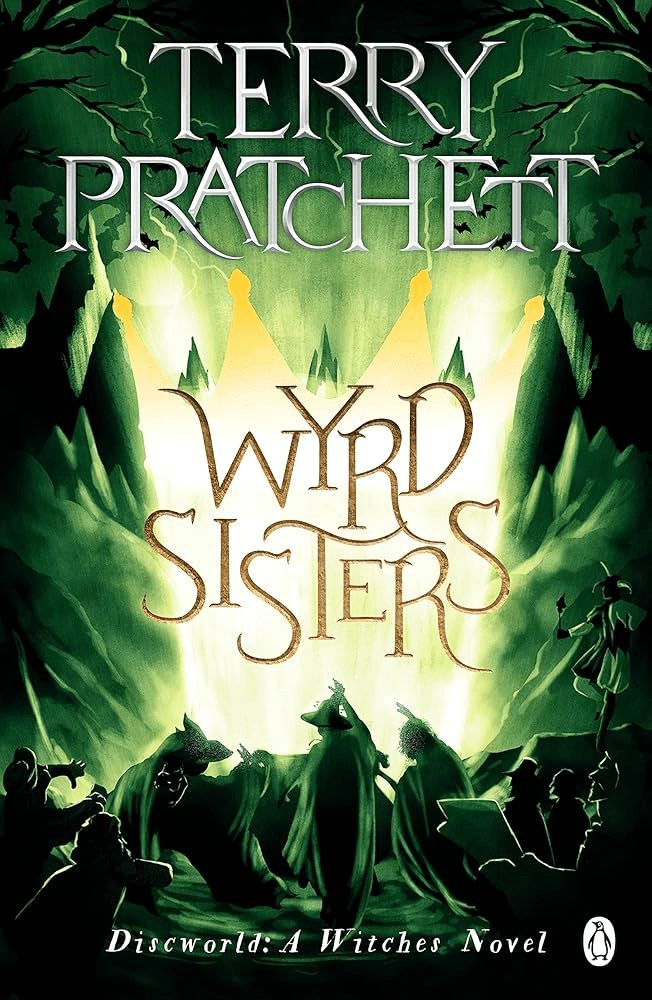
By Sir Terry Pratchett
So, for the last time until November, we return to Discworld. We are looking at the second book with Granny Weatherwax and the first book that introduces the other witches. Before we go any further, here is a bit of housekeeping. Next week we will go on to talk about Dracula for Halloween.
“Destiny is important, see, but people go wrong when they think it controls them. It’s the other way around.
Three witches on a lonely heath. A king cruelly murdered, his throne usurped by his ambitious cousin. A child heir and the royal crown, both missing.
Witches don’t have these kinds of leadership problems themselves – in fact, they don’t have leaders.
Granny Wetherwax is the most highly regarded of the leaders they don’t have. But even she finds that meddling in royal politics is a lot more complicated than certain playwrights would have you believe. Particularly when the blood on your hands just won’t wash off…”
This was a lot of fun. This is the first Discworld that I am reviewing where we get to look at Sir Terry Pratchett’s brand of parodies. This book looks deeply into how an identity can be portrayed through a person’s profession.
I have three things that I would like to talk about.
Firstly, there are many books written by Sir Terry Pratchett where he takes an idea or story, then dissects and reworks it until he can make a story that can stand on its own, where you don’t need to read the source material to understand things. This book is a mixed bag of characters from different Shakespeare plays. From Macbeth, we have the three witches who regularly quote the Wyrd Sisters, and the Duke and Duchess have played the roles of the Macbeths, but only one of them feels the guilt of their actions. From Hamlet, we get the ghost of the previous king and the play in the end “Wherein I’ll catch the conscience of the king!” and while there are many different Fools in Shakespeare, the Fool Verence is a very timid version of those fools. The thing that makes Wyrd Sisters work is the fact that we don’t need to recognize the references for this to be a great book. For example, I first read this book before I had ever seen Macbeth, and I still loved it.
Secondly, the idea that the land can have a say on who it may want to rule it. When we hear about the previous king, he wasn’t a good man. He hunted people and burned down people’s cottages, but because of the way he did it and the fact that he loved the land, he was seen as a good king. It seems that in the Discworld, you need to love the land you rule and not just the act of ruling.
Thirdly, I would like to look at the idea of identity that can be portrayed through a person’s profession. There are two different people who show different sides of this idea. Firstly, the Fool. It is obvious from the moment we are in his head that he hates every aspect of his job. The only reason that he is even doing it is that it was the family profession, and he can’t leave because he swore to be loyal to his Lord till death. Also, the reason why I referred to this character as a more timid version of a Shakespearean fool is the fact that in Shakespeare and in history, fools are the only people who were able to mock the king, but Fool Lawrence is too scared to try that. Secondly, Magrat Garlic. This is someone who chose to become a witch and did everything she could to be the best witch she could be. The comparison is fascinating; it seems that there is more happiness in finding your profession. There is a third person who fits this idea, but to look at Tomjons professional path, we would have to talk about it on the 3rd of November when we look at Witches Abroad. Until next week in Transylvania
Happy reading to all, and to all a good night.
 The Last One To Talk
Leave a comment