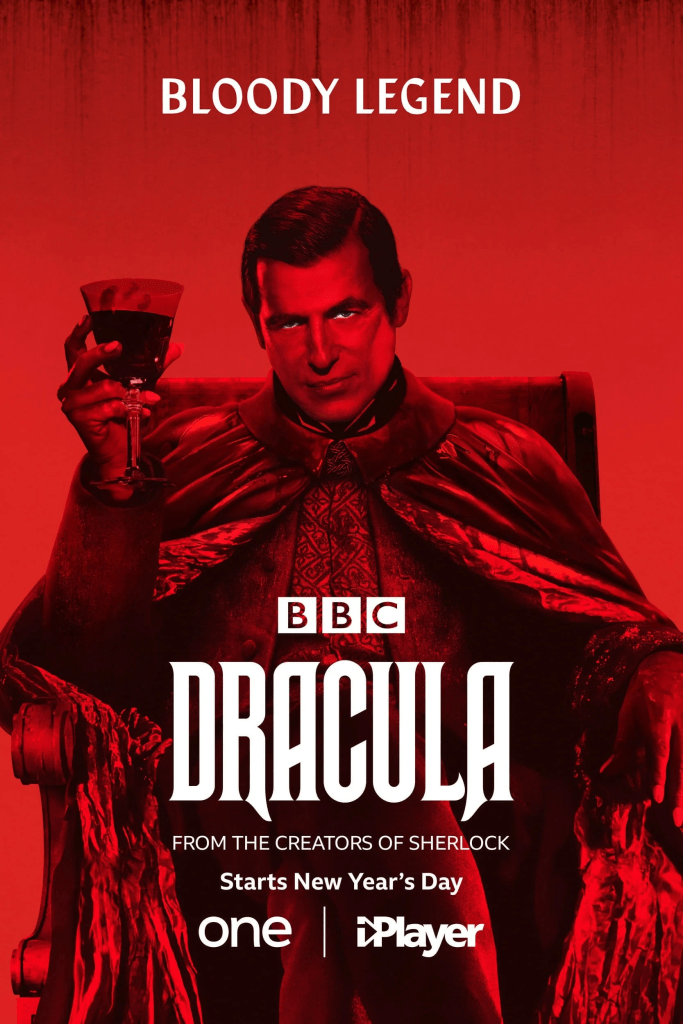
And now we come to the last of the Halloween content with this Dracula adaptation, the BBC Mini-Series. Before we get on the review, I should tell you that next week, we will return to Discworld and the Witches series.
“Dracula is a British television mini-series developed by Mark Gatiss and Steven Moffat that is set for broadcast and release on BBC One and Netflix, consisting of three episodes. It provides another interpretation of the Dracula character, who is portrayed by actor Claes Bang. Dracula premiered January 1, 2020, and was broadcast over three consecutive days.”
This is an interesting adaptation, but something you should know: this adaptation moves further from the book as it goes along. That being said, Mark Gatiss and Steven Moffat have made it their own. For anyone who is wondering, there is a lot of blood in this show.
For those who haven’t read my reviews of a TV show, I tend to just spill my thoughts about each episode, instead of a specific number of thoughts.
Episode 1: The Rules of the Beast. This episode starts off with a surprising change with the introduction of the framing device. This is Jonathan Harker in an abbey retelling the story of his trials in Dracula’s castle. This is where things start to diverge, because in the book he recovers in an abbey and the shock has turned his hair white. This version of Jonathan Harker looks like one loud noise away from dying right there.
Two rules about vampires were created in this adaptation. Firstly, the idea that if a vampire feeds on a person, that vampire gains knowledge and traits from their victim. This is shown by the fact that after Dracula feeds on Mr Harker, he not only looks younger but gains an English accent.
Secondly, the idea that if you are fed on by a vampire and die, you become undead, but not a vampire unless you drink blood. If you don’t, then you rot while being fully aware of what is happening the whole time. This leads to Dracula nailing his victim in a box. There is a psychotic neatness to this.
There are times when you can recognise a writer by the character they create. Even if I didn’t know that Mark Gatiss and Steven Moffat wrote this show, you can see the shadow of Jim Moriarty in Dracula. Both Dracula and Moriarty have a calm threat whenever they are in the room. Also, when it comes to Claes Bang, this might just be my opinion, but he looks a bit like Bela Lugosi.
Agatha van Helsing is a very interesting character because, like her book counterpart, she is Dutch and a little bit goofy. But it also makes sense that if anyone would study how to fight vampires it would be a nun. She has an interesting banter with Dracula as she stands her ground against him.
Episode 2: Blood Vessel. This episode covers one small section of the book. In the book, we see the ship Demeter run aground with the captain tied to the wheel, his diary in his pocket, describing how his crew died off one by one. What the show does with this is pull from great tropes of horror and murder mysteries. There is someone or something killing off the passengers and crew, but there is no way to leave. The change to adding more people on board is interesting because it not only adds more bodies to possibly kill off, but it also gives more opportunities. Especially because one of the passengers is a scientist who had experience with the living dead.
Throughout this episode, we keep flashing to Dracula and Agatha in a room playing chess and discussing what is happening on the boat. It isn’t until the halfway point that it is revealed that Dracula has been feeding slowly on Agatha as a way for him to keep her around because he generally seems to enjoy their back and forth.
It does come as a bit of a shock when Agatha sends Dracula down with the ship and he arrives on the shore in the present. This is a good twist because from this point, we go even further off the rails, and it is harder to predict.
Episode 3, The Dark Compass. This one has some issues, but also some good things. Firstly, the way they get around the trope of a person from the past being confused by the future is by using the knowledge of his victims to survive. Secondly, I enjoy the idea of the Harker Foundation, but I have one question: if you run a foundation that is dedicated to finding Dracula and you find him, why would you put your fingers in his mouth?
The fact that Dracula is only in England in the present leads to a modern Lucy. So I can accept that her suitors in the book are seen as her multiple flings and one gay friend. The idea that she is willing to let Dracula feed on her feels a little weird. And what sets this adaptation apart is the fact that Dracula seems actually to love her because she was not scared of death.
Ok, this is my biggest problem with how the show ends. These are the issues I was talking about. Firstly, throughout the first two episodes, there is the question as to why Dracula is affected by holy objects, sunlight, and the need to be invited in and here we are told that it is all in his head because he fears death. This makes no sense. We have seen him start to smoke with reflected sunlight. Secondly, this series ends with Dracula committing suicide by drinking the blood of a person with cancer. Now, the idea that a sick person’s blood would affect a vampire makes sense, if a person eats bad meat, they get sick. But Dracula committing suicide feels like a cop out.
When looking at this show, the first two episodes are excellent, but I feel like the third part is a bit of a let-down.
Anyway, until next time in Discworld.
Happy reading to all, and to all a good night,
 The Last One To Talk
Leave a comment