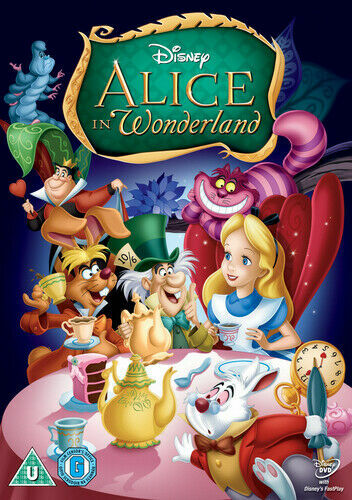
Here we come to the Disney adaptation that has become the norm. This is a movie I have no idea when I first watched because, when I was young, we had the Disney Channel, meaning I probably saw it in bits throughout my childhood.
“Disney’s 1951 animated Alice in Wonderland follows a young, bored girl who chases a White Rabbit down a hole into a nonsensical, psychedelic world. She encounters bizarre characters like the Cheshire Cat, Mad Hatter, and Queen of Hearts, shifting in size while navigating chaotic tea parties and croquet games, eventually waking from the vivid dream.”
If you have never seen this movie or read the book, then firstly, you probably will still recognize the characters because the Disney Alice iconography has been deeply saturated in the culture; this is where the idea of Alice’s dress being blue comes from. Anyway, you really should watch the movie as it is a peak classic Disney.
For this story, I have three thoughts.
Firstly, I would like to talk about the animation and the production of the movie. Looking at the history of the adaptation, I was very surprised that for a large part, Mr. Disney was making plans for this movie; this was going to be a hybrid film with Alice and her world being live action and Wonderland being animated. Now I am not saying that this idea would be stupid, the image of an animated white rabbit in the real world would be amazing, but in Walt Disney’s lifetime, they only did small scenes of a hybrid nature. It won’t be until 1988 until they made a full hybrid movie. I am glad that they made this movie fully animated, you can warp and change as much as the animator wants to. It adds to the dream logic of everything.
Secondly, I would like to talk about the part of the adaptation that is pulled from the book’s sequel, Alice Through the Looking Glass and What She Found There. Two different things get pulled from the second book. Firstly, it is the part where Alice sings with the flowers. The only difference is that Alice is her normal height in that book, so she can threaten to pick the flowers when they annoy her. In the film, the flowers yell at her for thinking she is a weed.
Secondly, is the introduction of Tweedle Dee and Tweedle Dum with the restoration of the Walrus and the Carpenter. This is an interesting addition because the thing that is missing in the registration of the nursery rhyme about them. I believe that this change has led to the idea that these characters are a creation of Lewis Carroll.
Thirdly, ok I would like to talk about a difference between the book and movie that seems to try to teach a lesson that is not in the book. In this adaptation, it starts with Alice singing about her Wonderland, then halfway through the movie, she sings about how she regrets getting herself into this situation. Finally, near the end of the trial scene, like in the book, Alice starts to grow and takes the chance to talk back to the queen, then wakes up. But in the movie Alice returns to her normal size before being chased by most of Wonderland before begging herself to wake up. This leads to a moral of “be careful what you wish for. “ This feels like the exact opposite of the original book, where Alice’s sister imagines grown-up Alice telling her grandchildren about Wonderland.
This was a lot of fun to come back to, looking at this movie, especially because I reviewed the Peter Pan movie last year. Both were made at the same time and came out one right after the other. Anyway, until next week, when we look at the first of two live-action adaptations.
Happy reading to all, and to all a good night.
 The Last One To Talk
Leave a comment