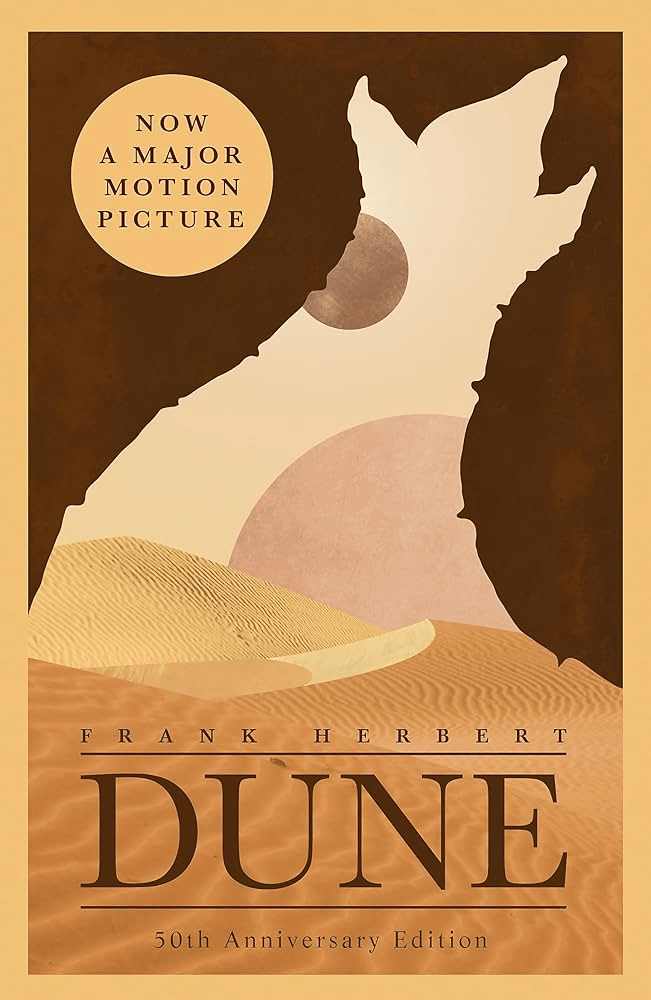
By Frank Herbert
This is a book that I first discovered in one of the stranger ways. When I was in university, one of the podcasts I listened to regularly was Stuff to Blow Your Mind. They had two podcasts on the biology and technology of Dune. I listened, having never heard of it before and then pushed it to the back of my mind. Fast forward to 2021, when the movie came out. I asked and received the book because I wanted to read it before I saw the movie. I knew that the first movie would cover half the book, so I guessed how far I would need to read to understand the movie. I guessed wrong.
Before I go on to the review, I need to do a bit of housekeeping. I will be reviewing the 6 Dune books as well as the 1984 Dune movie, Frank Herbert’s Dune 2000, Children of Dune 2003 and the two parts of the latest Dune movie.
“Here is the novel that will be forever considered a triumph of the imagination. Set on the desert planet Arrakis, Dune is the story of the boy Paul Atreides, who would become the mysterious man known as Muad’Dib. He would avenge the traitorous plot against his noble family—and would bring to fruition humankind’s most ancient and unattainable dream.
A stunning blend of adventure and mysticism, environmentalism and politics, Dune won the first Nebula Award, shared the Hugo Award, and formed the basis of what is undoubtedly the grandest epic in science fiction.”
This is a fascinating book mainly because there are so many books and movies that drew from it, whether it is the political machinations in Game of Thrones or the many different things in the original Star Wars movies. Something you should be aware of before you read this book it is 675 pages long and incredibly dense. But if that doesn’t dilute your enjoyment, then come with me to Arrakis.
For this story, I have four thoughts.
Firstly, I would like to talk about the Butlerian Jihad, which for anyone who has never read the book, the Butlerian Jihad was the war against thinking machines, centuries before the first book. This means that this is one of the few sci-fi books without robots or computers. The idea is that people would notice the effect that having thinking machines would have, and fight against them. And all of this is just the backdrop. Mainly because, without thinking machines, the people of this world had to get creative with human development. A great example of this is the Mentats, people who are trained from childhood to think like computers.
Secondly, I need to talk about the framing device of every chapter, especially the sections from the Princess Irulan. This is interesting because it sets the story in its own history. We know from the get-go that Paul will be important for that universe. I know this tactic of including the world’s history books was common at that time, but it is something you don’t see a lot. Also the fact that Paul’s name is in the history books means that there is less worry about his imminent death.
Thirdly, Frank Herbert teaches conservation with both water and the Spice. As the summary said above, there are a lot of themes of environmentalism. In this book and beyond, we see that Spice is a substance that allows many parts of this universe to function. But the better way that we see the need for conservation is in how precious water is on Arrakis. This is seen firstly because of the need for everyone to wear suits that capture a body’s water, and the Fremin locals have developed ways to harvest the body’s water from the dead. Now, the idea that such water sourced is definitely alien to me as someone living in England, I not only have clean water on tap, but I am currently a 15-minute walk from a river. But the fact that this book can make me think about my water usage in my day-to-day life is a testament to how powerful this book is.
Fourthly, I would like to talk about the plots and the way they divert. In one of the early chapters, we meet the Harkonnens, and we hear of all their devious plans and throughout the first part of Dune, we have to sit with the fact that the Harkonnens seem to be working with the inevitability of a Greek tragedy. But when we get on to the latter part, even after ruling Arrakis for 80 years, the Harkonnes never bothered to think about the locals. This shows the ignorance of the entitled.
Thank you for joining me for this journey, and until next week.
Happy Reading to all, and to all a good night.


Leave a Reply