By Frank Herbert
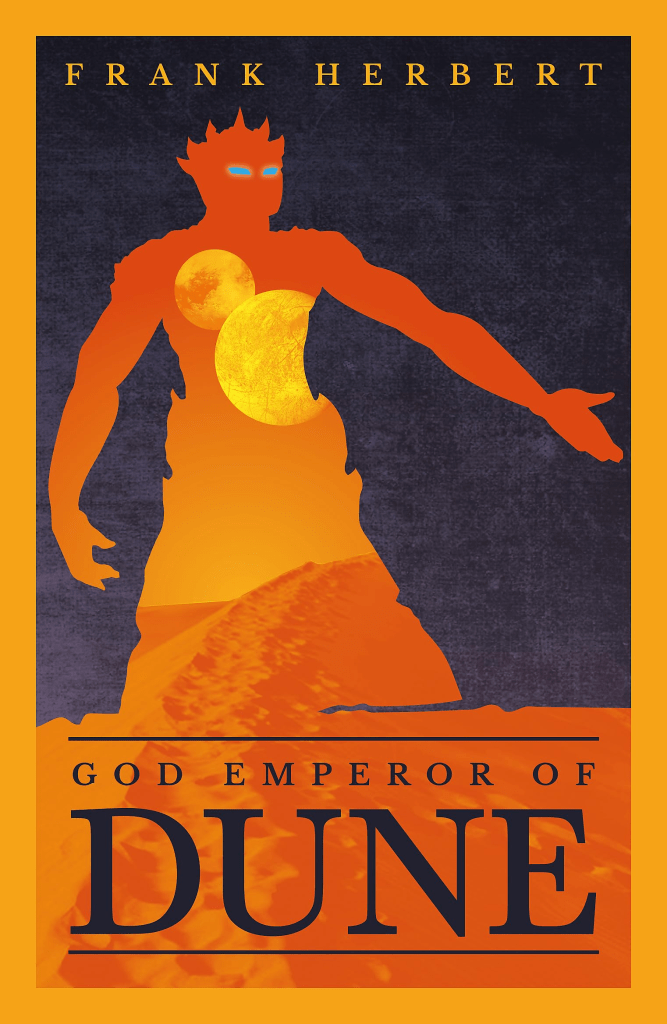
So we are at the fourth book, apparently, where Frank Herbert planned to write a trilogy, one plateau book in the middle and a second trilogy.
“More that three thousand years have passed since the events first recorded in Dune. Only one link survives with those tumultuous times: the grotesque figure of Leto Atreides, son of the prophet Paul Muad’Dib, and now virtually immortal God Emperor of Dune. He alone understands the future, and he knows with a terrible certainty that the evolution of his race is at an end unless he can breed new qualities into his species. But to achieve his final victory, Leto Atreides must also bring about his own downfall…”
This book is where it gets weird. Google Leto II and you will see what I mean. This book is 3500 years in the future. It is so fascinating how the time jump changes so much. Especially because we have now lost so many characters that we have fallen in love with just by the passing of time.
For this story, I have four thoughts,
Firstly, I would like to talk about Leto the worm person. As I said above, this is the book that starts getting weird, and a good part of this is the fact that we see the end process of Leto becoming one with the sand trout. Funny thing from when I first tried reading Dune, one of the podcasts mentioned a man who was part sandworm. At the time, I brushed that off, but now I am fascinated by how he is described. But I do realize why this book has never been adapted, it would be a headache to create in real life.
Secondly, I would like to talk about the Golden Path. This was something that we heard about in Children of Dune, but we didn’t get much of an explanation. The Golden Path is seen as the only way that humanity will survive. Now the hows and whys are explained, there are many lines where Leto talks about how humanity will react to his enforced peace and limited transportation by developing to hate such control and to scatter out into the universe so far that humanity will never be wiped out. There is also a suggestion that the failure to spread was not the only problem, as we get a line that Leto’s rule had prevented at least one extinction event. It is left up to the reader to guess what that event was. Leto II seems to prove the quote “You either die a hero or live to become the villain.”
Thirdly, Duncan Idaho again. The man is very interesting because for most of the book we see a Duncan that is new, meaning that everyone needs to explain everything to him, making the perfect point of view character. But one of the interesting things about him is the fact that he is the 60th Duncan Idaho, who has been sent to Leto II, which raises the question, why is Leto so insistent on having one?
Fourthly: rebellion. Within the first 100 pages of every Dune book before this, we get a chapter that shows a plan for a rebellion against House Atreides. But what makes a difference in this book is that we are actually hoping for the rebels to win. It is also interesting that our “villain” of the piece is also an Atreides with an ability that completely blocks her from Leto’s version.
Thank you for joining me, and until next week, far into the future.
Happy reading to all, and to all a good night.


Leave a Reply