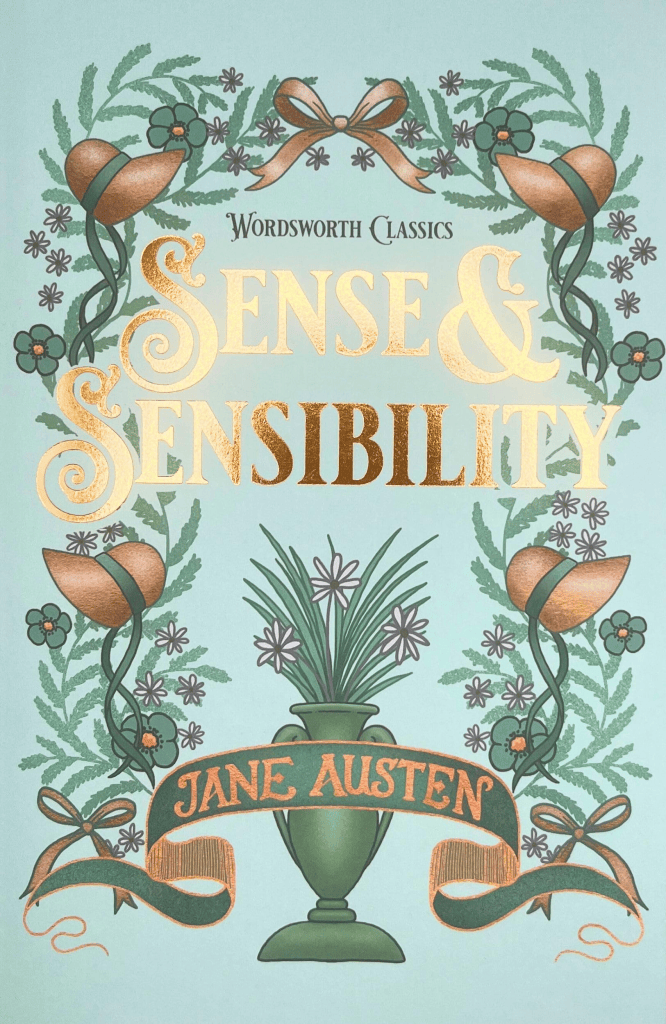
By Jane Austen
Welcome back to the Austen world. If you have read my Pride and Prejudice review, you will see my connection to Jane Austen and now on to Sense and Sensibility.
Before I go on, I need to do a bit of housekeeping. Next week I will be reviewing Sense and Sensibility and Sea Monsters, but due to being out of the country, that review will come out on Wednesday the 22nd. And the week after, we will return to the normal scheduling with the 1995 movie and then the 2008 BBC miniseries.
“Mrs. Dashwood’s husband has died, leaving her and her three daughters- Elinor, Marianne and Margaret- homeless and poor. They move in with distant relatives, the Middletons. Elinor is ruled by logic. When she learns beloved Edward is engaged to another, she keeps her heartache a secret. Meanwhile, Marianne lives by her emotions and is smitten with the dapper Mr. Willoughby. When he proves false, Marianne is devastated. Through a series of romances and heartbreaks. Elinor and Marianne learn to balance sense and sensibility to find happiness.”
This is a classic Jane Austen novel in all the ways that count, with a bit more of the dark consequences of this time.
For this story, I have four thoughts.
Firstly, the beginning of the book is Mrs Bennet’s nightmare. Throughout Pride and Prejudice, we repeatedly see Mrs Bennet going on and on about how Mr Collins will throw them out on the streets after Mr Bennet dies. If anyone reading the book and thinking that Mrs Bennet was being ridiculous, this shows why she was scared. And what makes it even worse is the spineless wimp of a stepson who lets his wife talk him out of his father’s wishes. I have no patience for this man.
Secondly, Willoughby. Now this is an interesting look at a Jane Austen villain. The reason I say this is the fact that he actually loves Marianne, unlike Wickham, who very much seduces Lydia in an attempt to ruin the Bennets. That is not to say he is a good man; this is still the guy who knocked up Colonel Brandon’s ward, refused to marry her when threatened with disinheritance, and then, when he knew his only path forward was to marry rich, still led Marianne on. My point is it is interesting to see a Jane Austen villain who has love but is not redeemed by it.
Thirdly, why can’t Edward just dump Lucy Steele. This was the main question after we find out that Edward and Lucy have been engaged for the last four years. The thing is, this question is answered by what happened with Marine after Willoughby gets married. She was emotionally ruined, and that is just after knowing Willoughby for a few months. Add to the fact that Lucy is now past what is considered a marriageable age, meaning she would have little to no chance of finding another husband. You can see that Edward chooses to do the honourable thing. Even if it means an unhappy marriage.
Fourthly, I need to talk about Lucy Steele. On the one hand, she is the only reason Elinor and Edward can’t get married, as we see above. But on the other, Edward’s family is so much richer than hers could ever hope to be. So it only makes sense to stay with Edward, and then move on to his brother. The lady acts like the regency version of Regina George with how she rubs her engagement in Elinor’s face. It does raise an interesting point with the fact that she actually has a good life after the book. It raises an idea that Jane Austen may not see her as a true villain. What do you think?
It was so great to get back to this author and until the 22nd.
Happy reading to all, and to all a good night.


Leave a Reply