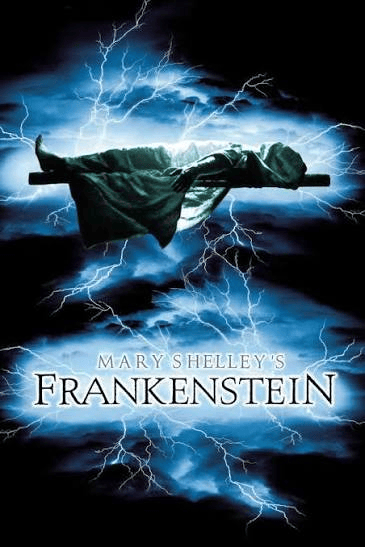
This was a fun movie. I only watched clips of this one while studying the book; it was great to come back to.
“Based on Mary Wollstonecraft Shelley’s novel, this movie tells the story of Dr. Victor von Frankenstein, a promising young doctor who, devastated by the death of his mother during childbirth, becomes obsessed with bringing the dead back to life. His experiments lead to the creation of a monster, which Frankenstein has put together with the remains of corpses. It’s not long before Frankenstein regrets his actions.”
This was interesting to see an attempt at a book-accurate Frankenstein adaptation. As I have said before, there are a class of movies that combine a classic work, a big budget, and all the great actors you can get, which is the perfect recipe for a movie.
For this movie, I have 3 thoughts.
Firstly, there are two impressive connections to the book right in the beginning. Firstly, there is the quote while we see the opening credits: “I busied myself to think of a story… which would speak to the mysterious fears of our nature and awaken thrilling horror—one to make the reader dread to look round, to curdle the blood, and quicken the beatings of the heart.” This is what Mary Shelley wrote about when she began to work on Frankenstein; it was a perfect way to start a movie bearing the author’s name. Secondly, it’s the inclusion of Captain Robert Walton, so this adaptation has the framing device from the book. It is interesting because it leads to the comparison between him and Frankenstein; we see Captain Walton claim that “I will be hailed as the benefactor of our species.” In the book, this is something that Frankenstein claims if he succeeds. This comparison is striking and makes the viewer glad when he turns back.
Secondly, I need to talk about the whole “no one should ever die ” thing from Frankenstein. In the movie, after Frankenstein’s mother dies, her son repeats the line “No one should ever die.” This is a point I want to talk about because in the book he just thinks about the acclaim he will receive if he succeeds. This change makes sense because this version of Frankenstein has a personal reason for what he is doing instead of a selfish one. This means that we are on his side, for the beginning at least.
Thirdly, how he made the monster. One of the things that people forget, if they only know about Frankenstein from the movies is that the book never says how he made his monster. This leaves it up to each movie to explain. Because Galvanism (the science that showed that by applying electricity to dead muscles they can move again) was one of the inspirations for the book, every adaptation includes electricity, usually from lightning. But what sets the movie apart is the fact that Frankenstein submerged his monster in amniotic fluid as part of the resurrection experiment. I can’t tell if this is an idea born of the image of rebirth or just for the shock factor or both, but it does stick out.
Thank you for joining me for this and until next week, when I look at the movie Victor Frankenstein.
Happy reading to all and to all a good night.


Leave a Reply