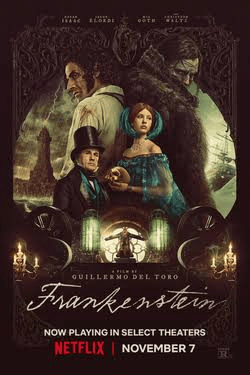
And now we come to the final movie, and the one that hit the nail in the coffin since I decided that I would review this book and adaptation for this Halloween, Guillermo del Toro’s Frankenstein (2025.)
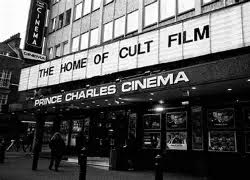
Before I go on, I have a bit of a Halloween treat for you. Last Monday I went to the Prince Charles with my dad, Henrik Hansen. We saw Abbott and Costello Meet Frankenstein, the Universal Frankenstein and finally The Bride of Frankenstein. My dad is starting his own blog reviewing movies he sees at the Prince Charles. The review for those movies will be at the end of this review.
Also a bit of housekeeping: after this I will be reviewing the Chronicles of Alice series.
“God created life, and He alone can take it away. However, Baron Victor Frankenstein, the arrogant son of the renowned physician Leopold Frankenstein, thinks otherwise: inspired manipulation of the human body and its intricate systems by physical and chemical means equals life eternal. His audacious plan is visionary, yet it is hanging by a thread; only access to ample resources can help Victor achieve transcendence. If only he knew the answers. With so much death out there and destiny calling, Frankenstein embarks on a blasphemous mission to disrupt God’s rhythm and imitate life. But what was once alive should remain dead forever. Or should it be the other way round?”
This was a beautiful adaptation that pulls from the book as well as making its own thing.
Firstly, I would like to talk about the 2 references to the book and 1 that might be a reference to The Bride of Frankenstein. Firstly, the framing device with Captain Robert Walpole. In the book, Frankenstein, Victor is telling the good captain about his life and how he got there. In the movie, we have the voice-over telling us all of his childhood, and when the monster shows up, he does the same. In the book, we do get the monster’s story; the only difference is this does not happen on Walpole’s ship. Secondly, there are many people who will connect Victor to Prometheus; for those who have not read the book, you may not know that the second title is “The Modern Prometheus”. Here is the one thing that might be a connection to The Bride of Frankenstein. In the movie, the creature lives with and learns from a blind man while the man’s family is out hunting wolves. The reason that I believe this is a reference to The Bride of Frankenstein is that, in the book, the creature tries to befriend a blind man, but that goes downhill fast when the family comes back; it is only in The Bride of Frankenstein that we see the creature learn from a blind man.
Secondly, the themes of fatherhood in Frankenstein. Going back to the books, there has always been a theme that runs under the surface. Mainly, the fact that if Victor had actually treated his creature like a human instead of a monster, things would have gone better. In this movie, we have Frankenstein trying to teach his creation when he first comes to life, but it results to a cane and then a murder attempt when his creation won’t say anything but Victor. Seeing that this version of Victor has been hit by his father raised the point that Victor doesn’t just need to be a father for his creation but specifically a good father.
Thirdly Elizabeth. This lady is incredibly different from how she is in the book in 3 different ways: firstly, the fact that when we first meet her in the movie, she is engaged to Victor’s brother. Secondly, she actually has an interest in science, and we see how Victor falls for her; the fact that she looks like his mother might also help that. Thirdly, we see her befriend the creature and be the first person to see him as a human and not a monster. This all leads to Victor accidentally shooting her on her wedding night, unlike in the book where the monster does, which leads to the answer to the question of who the real monster is.
Thank you for joining me, and I hope you enjoy the next review.
Happy reading to all, and to all a good night.
Universal Frankenstein Triple Feature
Disclaimer: I do not and never have worked for the Prince Charles Cinema. We have no formal
connection and I am not being reimbursed by them for my articles.
Many thanks to Lydia for allowing me to piggy back onto her blog to write about our trip into Central
London to the Prince Charles Cinema where we saw Universal’s Frankenstein (1931) and Bride of
Frankenstein (1935). Also, like an abnormal brain driving this gorgeous engine, the evening started
with Abbott and Costello Meets Frankenstein (1948), making for a truly splendid night out at the
movies. And it wasn’t even overlong. A&C M F clocks in at 86 minutes. The original Frankenstein is
70 minutes and Bride of Frankenstein is 75 minutes. For a properly long cinematic experience, wait
for my review of the French New Wave experiment in endurance, “Out 1.” It is 12 hours and 56
minutes long. That is not a typo.
That review will be coming soon, because this article is a back door pilot for my new blog, “Movies
I’ve seen at the PCC.” I’ve been enjoying all sorts of movies at the Prince Charles Cinema since the
late ‘90’s, when I lived in London. I now live a good hour away from the Big Smoke, but I still get into
Central London for something special at my favorite cinema, a couple of times a year. You will get
stories of odd things that have happened to me at this Mecca of Cult Movies. I will tell of the
screening of “Bad Santa” where I was the only audience member NOT dressed as Santa Claus. Also
all night marathons, sing-alongs and other spectacular events. Some reviews will just be reviews, if
seeing it at the PCC was a standard experience. In the last quarter century I’ve seen over 100 movies
there, and this seemed like a good way to focus my selection of movies to write about.
Located off of Leicester Square, The Prince Charles Cinema has been up and running since 1962,
when it had a seedy reputation. It was where you went if you wanted to see Caligula or Emmanuelle.
Hellraiser had its world premiere there. It was the little brat in the shadows of the towering Empire
Cinema and the Odeon Leicester Square. When the PCC was bought by Robins Cinemas in 1991, it
morphed into the Cult Cinema Repertory house it is now. On any given day you can find Art House,
World Cinema, Blockbusters, Silent Films with Live Music accompaniment, All Night Marathons and
so much more. I have been a Lifetime Member since the year 2000. For more information see
www.princecharlescinema.com and www.timeout.com/london/film/an-oral-history-of-prince-
charles-cinema.
My adult daughter Lydia and I attended this Halloween triple bill last Monday. We were in the
smaller Upstairs screen which seats just over 100 people. The upstairs screen was originally the
balcony but was split off in the 2000’s to allow for a more intimate space. All three Frankenstein
films were sold out as was Mullholland Drive, which was showing in the 300 seat venue downstairs.
Abbott and Costello Meet Frankenstein played beautifully with an audience. Lots of laughs. At the
PCC we are encouraged in a Housekeeping video to take a minute to watch the older films from the
inside, so to speak. Not to judge the movies from our superior position in the 21 st century. A&CMF
was a great lead in to our triple bill. Coming after the famous run of Universal Films, it played with
our expectations of The Creature (Glenn Strange), Count Dracula (Bela Lugosi) and The Wolfman
(Lon Chaney Jr.) In this movie, Chick (Abbott) and Wilbur (Costello) are delivery men who are tasked
to transport crates to a local House of Horrors. They contain Dracula and Frankenstein’s Monster.
Talbot (Chaney) is the troubled Wolfman who is bent on stopping Dracula from reviving the Monster
to full strength. Dracula and the mysterious Dr. Sandra Mornay (Lenore Aubert) plan to put Wilbur’s
brain in the Monster, so that he will be less aggressive and more pliable. Sandra is playing at being
Wilbur’s love interest. When she says she loves him for his brains, she means it!
The monsters are all played straight and the comedy came from Costello’s reaction to them. Lugosi
and Chaney were both brilliant in this movie. As Dracula, Lugosi still had those hypnotic eyes and
regal manor. The Wolfman was a tragic figure and Chaney hit the right level of sympathy.
Afterwards, Lydia pointed out that the wolf man needed to be better organised about the lunar
cycle. More than once, the full moon seemed to be a complete surprise to him. Considering he was
in the title, Glenn Strange’s Monster was given very little to do here. He is weakened at the
beginning and only comes into his own in the climactic chase/fight where our heroes run from room
to room, just to find one of the monsters waiting to jump out at them. It’s hard to see why it isn’t
called “Abbott and Costello meet Dracula.”
I grew up watching Abbott and Costello movies in Bay Village, Ohio on our local station, Channel 43.
This is the only time I have seen them as an adult, barring the odd rewatch of their “Who’s on First?”
routine. Lou Costello is a comic dynamo. So much energy, so many quick changes of reaction and
emotion. But on his own, it wouldn’t work. You need an Abbott to keep Costello reigned in, like
having boundaries and a net for tennis. Their line delivery is perfectly timed, their asides often
funnier than the big reactions. It easy to see why they had such a profitable string of movies in the
40’s and 50’s.
Next up was the original Frankenstein. We are presented with a theatre curtain. Edward van Sloan,
who plays Doctor Waldman in this film, enters and addresses us, saying that Mr Laemmle (Producer
and Head of Universal Studios) wished to warn us of the terror in store. “So, if any of you feel that
you do not care to subject your nerves to such a strain, now is your chance to, uh …. well, we’ve
warned you!” They waste no time setting the scene. We start at a graveyard where a funeral is in full
swing. After all the people leave, Dr. Frankenstein (Colin Clive) and his hunch-backed lab assistant
Fritz (Dwight Frye) skulk out and dig the poor corpse up again, and we’re off to the races. James
Whale is highly regarded in his direction of this and Bride. He established all of the visual cues we
know of Mad Scientists and their creations. Clive has great intensity and drive as Frankenstein. He
has a striking face and Whale uses Dutch Angles and closes ups to great effect. (Dutch Angles are
where the camera is tilted in an effective way. There were a couple of surprises for me. A small
cadre of Frankenstein’s friends arrive at the castle just as he’s starting his great experiment. In so
many other versions of this story, it’s all played out in absolute secrecy. Here, he revels in his
audience. “Quite a good scene,” he tells them before he starts. ”One man, crazy – three very sane
spectators!”
Then we come to the Creature. Billed only with a ? at the beginning of the film, Boris Karloff’s
Creature stands in the Pantheon of Movie Monsters. Under a lot of make-up, created by Jack P.
Pierce, Karloff brings the Monster to life with his soulful eyes and expressive vocal work. He is
limited to grunts and groans in this film and learns some basic vocabulary in “Bride.” After all of the
sequels, spin-offs, cartoons and breakfast cereals, it was powerful to see the OG Monster on the big
screen. He is very sympathetic, right from the start. He is abused by Fritz, who wields a fiery torch at
him while he is chained up. The Monster escapes and after some tragic interactions with the
villagers, he is forced to take refuge in a windmill. In this movie, the Creature is a victim. He has
more agency in Bride and really owns the mantle of Monster.
At the end we get the cast of characters again, (“A good cast is worth repeating” it says.) And this
time, Karloff gets proper billing. I highly recommend Frankenstein. At 70 minutes, it races by. The
tone is just right. Dark, brooding and with comic relief, sparingly used.
As opposed to “The Bride of Frankenstein” which ratchets up the comic relief to dizzying heights. It
starts with the Shelleys, Mary (Else Lanchester) and Percy (Douglas Walton) along with Lord Byron
(Gavin Gordon) on a dark and stormy night. Mary demurely does needlepoint while Byron
mansplains the plot of the original novel (that she wrote!) to give the audience a catch up on the
action. Then she tells them what happens next. We start exactly where Frankenstein left off, with
the villagers burning down the windmill with the Creature trapped inside. But the Monster, who did
NOT die, escapes and starts taking his deadly revenge. We are then introduced to Una O’Connor in
the role of Minnie, maid to the Frankenstein family. She carries nearly all the comic relief. In spite of
her clearly being the visual template for “Young Frankenstein’s” Frau Blucher (thunder clap, horses
neighing), her character is quite different. Mel Brooks used the exact same costuming and hair for
Cloris Leachman’s memorable turn in his outstanding parody, but whereas Frau Blucher is stern and
forbidding, Minnie is over the top, eye rolling, giving asides to the audience and also giving Lou
Costello a run for his money in double takes and comic reactions. We are set up for a very different
style of movie, swinging from horror to comedy in a spirited way.
The next major addition is Dr. Pretorius (Ernest Thesiger) who is a former colleague of Frankenstein
(still played by Colin Clive), who is reluctant to continue his experiments, after all the trouble he’s
caused the first time around. Pretorius invites Frankenstein to his own lab where he’s also been
playing God by creating life. He has a collection of tiny humans in glass jars. They are dressed up as a
King, a Queen, an Archbishop, a Ballerina and a Mermaid. They talk in high squeaky gibberish and
blow kisses at each other. It’s played for comedy, but it’s truly bizarre. Frankenstein is
understandably appalled.
Meanwhile, the Creature just wants a quiet life. He stumbles across the Blind Hermit (O.P.Heggie)
who befriends the monster without judgment. He plays the violin for him, teaches him some basic
English (“Bad”, “Good”, “Friend” etc) and offers him food and sanctuary. The scenes with the Hermit
are the warm heart of the film. Young Frankenstein lovingly recreated this bit with a delightful
cameo from Gene Hackman as the Hermit. In Bride, the Creature enjoys a bowl of soup and a cigar
and we had some light laughter in the cinema, as we anticipated possible injury to the monster. It
was all I could do not to shout out “Wait! I was going to make espresso!”
Pretorius convinces Frankenstein to create a mate for his Creation. (Frankenstein is surprised to
learn that the Creature is a) alive and b) can talk now.) “Friend Good!” Elsa Lanchester endured a lot
of make up, tight bandages, stilts and a wired lattice for her iconic hairdo as the Bride. She has a very
short amount of screen time, but makes an indelible impression. She hisses and spits, reportedly
mimicking swans. Her physical performance, coming to grips with her own reality, is spellbinding.
She got cheated out of proper billing, however. Like Karloff, in the Cast of Characters at the
beginning of the film, her character is marked with a “?”. But unlike him, at the end of the film, the
Bride is still a “?”. Lanchester only gets credit for playing Mary Shelly! It took until “The Bride” (2025)
for the titular character and Mary Shelley for that matter, to get their proper due.
I hope you will enjoy the original Frankenstein and Bride of Frankenstein for your Hallowe’en
entertainment. Feel free to throw A&CMF in there too, if you want a proper monster mash.
Next time: Godzilla Minus Zero (2026)


Leave a Reply