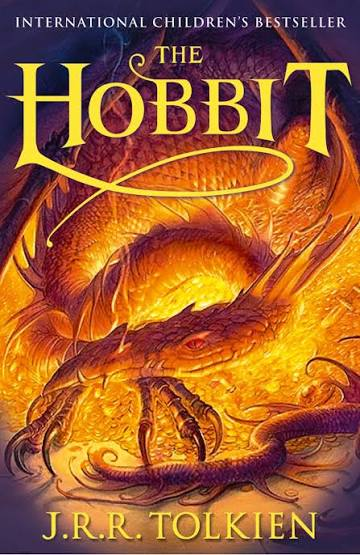
By J.R.R. Tolkien
This is a book that has lived throughout my childhood. I don’t quite remember when Dad read the book to me but I do remember saying when I was done that I wanted to see the movie. I think that we were reading a lot of books for movies coming out.
Housekeeping, as said before, next week I will be reviewing the three movies and skipping the animated movie due to lack of funds.
“Whisked from his comfortable hobbit hole by Gandalf the wizard and a band of dwarves, Bilbo Baggins finds himself caught up in a plot to raid the treasure hoard of Smaug the Magnificent, a large and very dangerous dragon…”
This and its sequel series are the foundational bricks of most of modern high fantasy. It has been a few years since I have read this book, and it was still a pleasure.
For this story I have 3 thoughts.
Firstly, there are two different edits of this book that I know about. The first is one that I know a bit about; apparently, in an early draft, Bilbo was the one to kill Smaug and jump into a large cup to avoid the wave of blood that came out. That is all I know about that draft; it does bring up the question of how the book would turn out without Bard? Secondly, there are two published versions of The Hobbit. When he first wrote The Hobbit, the ring was just a magic ring that Gollum was fully willing to give as a reward for winning the riddle game. When he couldn’t find it, Bilbo suggested that Gollum could show him the way out instead. It wasn’t until he went on to write the Lord of the Rings trilogy that things changed. He did a reprint of The Hobbit, and, along with some grammatical changes, he made the book we know today. The best part about this is there is an in-world reason for the change. The first version was the lie Bilbo told the dwarves, and the second version is the truth that Bilbo told Gandalf later on.
Secondly, the World Wars. One of the things that is well known about Mr. Tolkien is that he hates when people compare The Lord of the Rings to the Second World War, specifically comparing the One Ring to the nuke. He would say that this is ridiculous because if that was true, then both sides would try to make them. So, I’m about to annoy Mr. Tolkien’s ghost. I can see different connections between this book and the First World War. Firstly, the description of the battlefield after the war can be compared to Flanders Field. Secondly, the fact that the only dwarves of name that died in battle are the ones who had the most to lose. Thorin is the would-be king; Kili and Fili are Thorin’s heirs. A comparison can be made to all those promising young boys who went off to war thinking it would all be over by Christmas, only to come home in a box if they were lucky. This is especially poignant as the book states that Kili and Fili are the younger dwarves there.
Thirdly, Thorin vs Bard: what it means to be a king. In The Hobbit we see two different kings come into power. First to look at is Bard; the reason that he is interesting is even though he has royal blood in him, before Smaug’s attack he shows no interest in taking power. He is pushed into power more after he saves the town. But when he came to Thorin’s gate to ask for both the money that he promised and more money to cover the damage that Smaug did, Thorin shows what kind of king he is. Now, in most classical tales that this one is built on, the person in Thorin’s standing would be gracious in sharing his wealth with his neighbors in need. The fact that he does the opposite shows how currently unfit he was for the throne. I have heard it said that in Tolkien’s world anyone who grabs for kingship for what it will give him is unworthy of it. That truly fits here.
Thank you for joining me in this return to a classic, and until next week.
Happy reading to all and to all a good night.


Leave a Reply