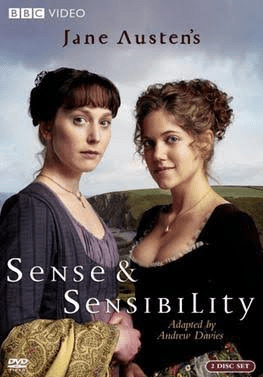
This is an adaptation that I didn’t know about until I went to look into other adaptations. And now I have, I definitely like it as much as the movie.
Before we go on, I need to do a bit of housekeeping. Next week I am going to review The Hobbit, and the week after that I will review the three movies. Now, before I get any comments about the animated Hobbit movie, I am aware that it exists, but currently this blog is on a tight budget and buying a £20 DVD is not in that budget. That is to say, if enough people donate to the blog, it might change in the future. The donation link is on the home page.
“Widow Dashwood and her three unmarried daughters, Elinor, Marianne and Margaret, inherit only a tiny allowance, so they move out of their grand Sussex home to a more modest cottage in Devonshire. There, the prevailing ambition is to find suitable husbands for the girls. With help from wealthy neighbour Sir John Middleton, suitors for Elinor and Marianne are soon found–but not landed. They include dashing Willoughby, future vicar Edward Ferrars, and retired colonial gentleman Colonel Brandon.”
I enjoyed this show; it was a lot of fun to see how two different adaptors would work on the same text. I should say that this one is a bit darker. It is also on the BBC, and they always have the cream of the crop when it comes to British actors.
I will be a bit more free-flowing with my thoughts than my book and movie reviews.
Episode 1.In all other adaptations, the story begins with Mr Dashwood dying and charging his son to take care of his stepmother and his half-sisters. This time, we see the BBC version of a sex scene between Willoughby and Eliza Williams, who, if you don’t know, is Colonel Brandon’s ward. The reason this is interesting is that, chronologically, this happens first; it is usually left as a frill later on. Showing this first sets a very different tone. We don’t see Willoughby’s face; we just hear his voice. So it is incredibly possible that if someone hadn’t read the book, we might not know who this man is until we hear him speak.
It is interesting to see Elinor acting as the adult when her mother is not being realistic about what they can now afford. Mrs Dashwood is looking at places that, while they are smaller than Norlands, are still out of their current budget, and it’s up to Elinor to be the responsible one.
This version of the cottage looks a lot shabbier than in the movie. There is no suggestion that these Dashwoods brought servants with them.
This one has Colonel Brandon and Marianne interacting more than in the book. It is great that they have chemistry, unlike in the book, where they barely talk to each other.
Episode 2, the conversation between Colonel Brandon and Willoughby about his intentions is great. Both because any book reader will know why Colonel Brandon would question Willoughby’s intentions and because we know that Willoughby does actually care for Marianne.
In this adaptation, we see the trip to Allenham Court. In all other versions of Sense and Sensibility, Marianne and Willoughby drive off in a coach together with only a hint of what they were doing for all the time they were alone. This is the only version that shows it. Especially, we see them kiss, and before doing more, Willoughby stops this and takes her home. The fact that they do this much is a big deal. At this time, a young woman was never meant to be alone with a man. It’s that main reason why Kitty and Lydia Bennet were so desperate for balls and dances; it was the only time they could touch a suitor. The fact that they kissed would ruin Marianne’s reputation. Willoughby stopping says a lot about how he feels about Marianne.
A subtle thing in this miniseries is the fact that Anne Steel has an Irish accent and Lucy Steel doesn’t have one most of the time. What makes this special is the fact that the Steels are trying to hide how low-class they are and anything other than a proper English accent would be low-class.
They added a part from the movie in the show. Specifically, where Lucy meets Robert Farris, this doesn’t happen in the book. The main difference is that there is no chemistry between these two. This means that when Lucy does seduce him, it will be purely economic.
The way that the whole room stops and stares when Marian calls out to Willoughby is perfect because it shows she is acting with no propriety in her heart. When Willoughby acts like she is in the wrong makes him truly despicable.
Episode 3. I enjoy the fact that we see the duel between Colonel Brandon and Willoughby. In the book, there is only a two-line reference to this happening. This being a visual medium, it’s great to see it.
We actually see Cornel Brandon visiting Eliza Williams, and we hear her hope for Willoughby to come back to her, which kills the hope we had that he was a good man. This relates to what he did to Marian.
The part in the book where Marian and Elinor talk after they reveal details about Edward and Lucy is one of the emotional peaks of the book, as this book is about the bounds of sisterhood as much as anything else. This adaptation plays this scene perfectly.
When Colonel Brandon finds Marian, it’s high drama, especially because he is probably having a flashback to when he lost his first love.
When Willoughby shows up in the book, it is because he is afraid that Marian will die and he wants to explain himself. This version has him get called out for being a terrible person.
We have a montage of Cornel Brandon and Marian getting closer together, which I enjoy, as we see them fall in love. Especially because this is only shown in the epilogue of the book.
Thank you for joining me in the look at Sense and Sensibility and these adaptations, and until next week in Hobbiton.
Happy reading to all and to all a good night.


Leave a Reply